


Introduction to Arm Workouts for Beginners
Arm exercises are crucial for increasing upper body strength, which helps with everyday tasks and athletic performance. The arm workout regimen may be thrilling and difficult for people who have never done strength training. In addition to strengthening the arms, a beginner-friendly arm training program that increases muscular endurance and basic strength should work both the biceps and the triceps.
There are several advantages to arm exercises when beginning an exercise regimen. Arm strengthening, grip strength development, and prevention of shoulder joint injuries from other exercises help improve posture. Arm exercises are crucial for the following main reasons:
- Enhances daily functionality
Lifting, carrying, and pushing items are just a few of the everyday tasks that are made much easier by strong arms.
- Improves general physical fitness
By establishing a well-rounded upper body training regimen, arm exercises help to improve general physical fitness.
- Gains you confidence
Making progress and experiencing the power in one’s arms will boost one’s self-esteem and keep one inspired to keep exercising.
The fundamental workouts are meant to help you gain confidence and strength. Add pounds to dumbbells gradually as your strength increases, and experiment with their more complex versions. In this manner, a beginner may build a solid foundation for arm strength and set the stage for more complex exercises if consistency and concentration are maintained.
Basic Arm Exercises
Simple arm exercises are an excellent place to start if you want to build upper body strength, endurance, and tone. These exercises, which range from basic equipment like resistance bands to body weight alone, focus on the biceps, triceps, and forearms and represent fundamental movements that may be further developed into more complex forms. The overview that follows includes bodyweight and resistance band workouts that are suitable for people of all fitness levels.

Resistance Band Exercises
These multipurpose tools assist in strengthening and growing arm muscles by applying stress across a range of motion. They are perfect for at-home workouts or when a portable strength training device is required.
| Exercise | Target muscles | Reps | Sets | Tips |
| Bicep band curls | Biceps | 12–15 | 3 | Put both feet on the band, grab the grips, and gently curl up while gripping your biceps at the top. |
| Tricep extensions | Triceps | 10–12 | 3 | Keep your elbows as near to your head as you can while you completely extend your arms while holding the band overhead. |
| Band pull-aparts | Shoulders, upper back | 15 | 4 | Keeping your arms straight, grasp the band in front of your chest and pull it apart. |
Let’s take a closer look at each type of training with an expander. Namely, effective methods and tips for athletes:
- Band curls for the biceps
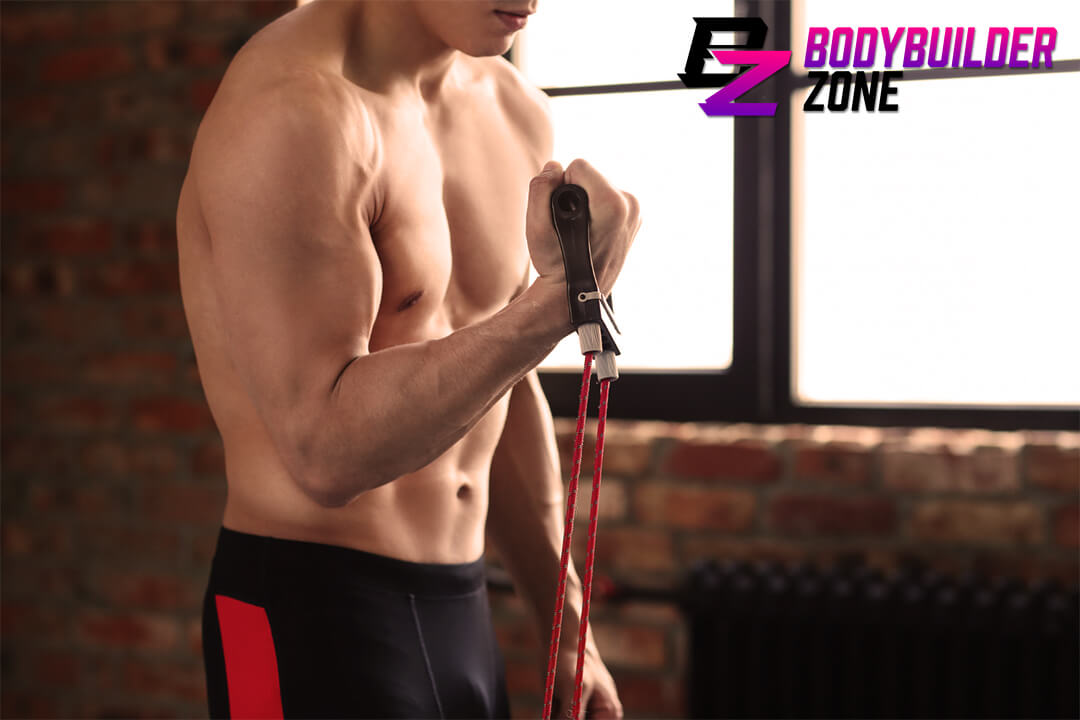
Holding the grips, place both feet on the band. Control your movement and maintain your elbows tight to your torso as you curl up. This increases grip stability and builds bicep growth and strength.
- Extensions of the triceps
Extending your arms upward while maintaining a firm elbow position, hold the band in both hands at the back of your head. By successfully isolating the triceps, you may develop tone and strength in the rear of your arm.
- Pull-apart bands
Using your shoulders and upper back, pull the band apart while holding it at shoulder height. strengthens the muscles in the arms, shoulders, and posture.
These exercises are great for both beginners and advanced athletes. You can do them at home using a regular expander and develop your arm muscles.
Bodyweight Arm Exercises
| Exercise | Target muscles | Reps | Sets | Tips |
| Push-ups | Triceps, chest | 10–15 | 3 | Maintaining a straight body, push yourself back up after lowering yourself until your elbows are at a 90-degree angle. |
| Tricep dips | Triceps | 8–12 | 4 | To get the most tricep engagement, use a stable surface, keep your elbows tight, and descend with control. |
| Plank to push-up | Triceps, shoulders | 8–10 | 3 | Lower yourself onto your elbows from a plank posture, then push yourself back into a plank position. stabilizes the arms and core. |
| Diamond push-ups | Triceps, inner chest | 8–12 | 3 | To work the triceps, keep your elbows stiff and your hands in a diamond form. |
Arm workouts using body weight are excellent for developing strength without the need for any special equipment. These workouts tend to be comfortable and efficient since they use your own body weight as resistance.
- Push-ups
Place your hands shoulder-width apart, bend your elbows to a 90-degree angle, and then push yourself upward. strengthens the chest and triceps while working the core muscles.
- Dips for the triceps
With your hands shoulder-width apart and your torso near the bench or chair surface, lower yourself by bending at the elbows while seated on it. In order to tone and strengthen the back part of the upper arm, this exercise works the triceps hard.
- Plank to push-up
Start in the plank posture and force yourself back to the full plank position after lowering each arm to the forearms. To improve stability and endurance, the entire arm, shoulder, and core muscles are used.

Because of this, regular use of resistance bands and body-weight workouts thoroughly tones and strengthens the arms without the need for bulky equipment. Along with strengthening specific muscle groups, these exercises help improve functional mobility and arm definition in general.
Importance of Consistency
Consistency in arm training is the key to achieving the long-term, steady results you desire. Your muscles get stronger and even more tolerant to the repetitive stress they experience once you can stick to a regular routine. Muscles will find it difficult to gain strength or endurance if the training is inconsistent, and progress will be delayed.
- Progressive gain of strength and muscle
When muscles are regularly under stress, which is what exercises give, they expand. Muscle fibers sustain microscopic tears throughout this consistent training process, but they come back stronger and larger, resulting in a noticeable increase in muscle mass and strength.
- Better method and management
You may improve your form and neuromuscular habits by repeating the workout. Your nervous system can adjust to each workout with consistency, leading to far more regulated and fluid motions.
- Increased drive and self-control
Consequently, mental resilience is developed. It becomes simpler to overcome these obstacles as your program becomes more consistent, allowing you to work out even when you don’t feel like it.
- Preventing injuries
Regular exercise increases the likelihood that you will use the correct form and technique, which lowers the risk of injuries from sloppy posture or hurried movements.
- Monitoring your development frequently
Record the weight, sets, and repetitions. You’ll be able to view your progress graphically. Small victories may also boost motivation, so acknowledge and enjoy them.
You may see improvement graphs by recording sets, repetitions, and weight. Even acknowledging and celebrating little accomplishments can provide further encouragement. By being consistent, you can create a solid foundation for your arms to continue growing and strengthening, which will improve your overall performance during any workout.
Tips for Staying Motivated
It might be challenging to stay motivated when doing fitness activities, especially arm training. Occasionally, the thrill may wear off or the pace of progress slows. Nonetheless, there are several pointers that can help you maintain your concentration, adjust to setbacks, and keep going. Motivation isn’t always about energy; sometimes it’s about developing routines and mindsets that make it easier to keep to them.
- Establishing specific and achievable goals
Make sure your goals are clear and attainable. For example, instead of “getting big muscles,” consider “I will increase the weight I use for bicep curls by 5 pounds in a month.” A clear mental picture of objectives provides guidance and makes it easier to track progress.
- Honour little achievements
Whether it’s increasing the number of repetitions, lifting more weight, or adding another activity to the week, all improvement must be recognized. The little victories give you more energy and motivate you to keep going.
- Change up your routine
Adding variation to your routine different exercises, equipment, or training methods will keep things interesting. Circuit training and supersets are two excellent examples. Variety keeps you from becoming bored and helps you use your muscles in new ways.
| Motivation strategy | Benefit | How to apply |
| Set clear goals | Gives direction and purpose. | Start with a target (e.g., lift 10 lbs heavier). |
| Celebrate small wins | Boosts morale and confidence. | Track and reward each improvement. |
| Add workout variety | Reduces boredom and challenges muscles. | Switch up exercises, and use different equipment. |
| Find accountability | Creates external motivation. | Share goals with a buddy or join a workout group. |
| Reward consistency | Reinforces positive behaviour. | Treat yourself after consistent weeks. |
| Reflect on progress | Builds a sense of accomplishment. | Review workout logs monthly. |
By using these techniques, you create a solid motivating base from which to maintain your dedication and enjoy your exercises. Each of the following suggestions is crucial for creating a successful exercise and overall success, from establishing objectives and adding variation to your program to acknowledging accomplishments.
Conclusion and Next Steps
In conclusion, these 3 key components are necessary for the growth of the arms: patience, correct form, and a great deal of constant effort and labor. These exercises are essential for success. Maintaining proper technique and establishing specific objectives both help one make steady progress without becoming dissatisfied.
To achieve your goals and continue to progress, you must evaluate your performance on a regular basis and modify your routine to suit your needs. These could be further steps towards improvement:
- Plan a program
Create a weekly arm training schedule that includes all the curls, tricep extensions, and other workouts you may wish to do. Just keep in mind that this should accommodate your level of fitness and allow for relaxation.
- Track your progress
Use one of the various exercise monitoring apps or write in a workout notebook to keep track of your progress. By keeping track of your lifting weight, sets, and repetitions, you will be able to determine your development.
- Be adaptable
To keep the muscles from plateauing, increase weights, new workouts, or structural modifications as you gain strength.
Keep in mind that every step you take toward your objectives adds to your overall strength and fitness journey. As you develop a powerful, toned upper body, concentrate on long-lasting habits and relish the journey.










Leave a comment