


Choosing the right workout program for yourself can be a difficult task. Many different programs differ from each other and are aimed at the specific goals of athletes. It is necessary to consider many factors and clearly understand what you want to achieve through exercise. This can be a training and nutrition plan for weight loss, weight gain or improving body relief. Since everyone is unique, each program is selected strictly according to your goals and body parameters. Let’s take a closer look at the main stages of choosing the right workout program below.
- 1. Defining Your Workout Goals
- Muscle building
- Weight loss and fat burning
- Improving overall fitness
- Preparing for competitions or specific events
- 2. Assessing Your Current Fitness Level
- Beginner level
- Intermediate level
- Advanced level
- 3. Types of Workout Programs
- 4. How to Adapt the Program to Your Needs
- Adjusting volume and intensity
- Time constraints
- Adapting to personal preferences and conditions
- 5. The Importance of Periodization in Training
- Periodization for maximizing results
- Types of periodization
- 6. Common Mistakes When Choosing a Workout Program
- Starting too intensely
- Ignoring your body’s signals
- Underestimating the importance of rest and recovery
1. Defining Your Workout Goals
The very first step for every beginner will be defining the goals of the workouts. Carefully study each option and evaluate how suitable it is for you. The main goals of workouts are the following:
The very first step for every beginner will be defining the goals of the workouts. Carefully study each option and evaluate how suitable it is for you. The main goals of workouts are the following:
Muscle building
Increasing muscle mass is the most common training goal of many bodybuilders and amateurs. Building hard muscles is not that difficult and with regular training, it is quite possible to achieve the first results after 3 months.
Weight loss and fat burning
The fat-burning workout program is quite intense and requires a lot of activity from a person. Be prepared to move a lot and watch your diet, as well as count your calorie intake. To lose weight, you need to maintain a calorie deficit and do more intense exercises.
Improving overall fitness
One of your goals may also be to improve your overall physical fitness. This option is suitable for those who want to increase strength and endurance and maintain an active lifestyle. Improving overall fitness allows you to keep your muscles in good shape, maintain your figure and feel better.
Preparing for competitions or specific events
There are training programs aimed at intensive preparation for sports competitions. Before these events, the body must be in its best shape to show perfect results. As a rule, such a workout is one of the most difficult and requires a lot of effort in a short time. This training goal is only suitable for professional athletes.
You should seriously approach the choice of the workout goal, as well as sensibly assess your physical capabilities. This will help to avoid unnecessary health risks and minimize possible injuries.
2. Assessing Your Current Fitness Level
Assessing your body’s readiness for a specific workout program is the next important step. There are 3 main levels of physical fitness, as well as the characteristics of each:
Beginner level
This level is the most basic and means that the human body has minimal physical fitness. Its muscles have not experienced regular loads, endurance and flexibility are poorly developed and the risk of tissue injury is high. It is very important to start with minimal physical activity. If you suddenly start to exercise actively, you can expect severe pain and stretching of tendons and other tissues.
Intermediate level
Transition to the intermediate level of physical fitness of the body means that you are quite active and the muscles are regularly loaded. Your endurance has increased, and there has been progress in strength. Also, at this level, you can run a certain distance in a shorter time, work with heavier weights and notice progress. The main goal is to maintain this progress and gradually move on to more serious training and balanced nutrition.
Advanced level
Advanced level is achieved by professional athletes who have been doing this for many years. This can be evidenced by impeccable form, pronounced muscles, a relief body and high energy. For this level, it would seem that there is nowhere else to strive, but this is not so. In this case, you can try more challenging programs.
Remember that a specialist with many years of experience can determine your level and a suitable workout program. This can be a private trainer with a medical education, so you should contact only professionals.
3. Types of Workout Programs
Let’s look at what types of workout programs there are and their components. Please note that these are just examples. Some of the below may not work for you, as each person requires an individual approach.
- Strength training
A common request is to increase strength characteristics by increasing muscle mass. The training program includes a set of exercises such as bench presses, deadlifts, squats and pull-ups. Working out large muscle groups using free weights, exercise machines or your weight is a priority for this program.
- Cardiovascular exercises
This type of workout focuses on improving the cardiovascular system’s functioning. The best activities to increase your heart rate are running, swimming, cycling and jumping rope. Cardio workouts will increase your endurance and help you burn excess weight.
The unusual name of hybrid programs combines both strength training and cardio. In this way, you will simultaneously increase your strength and endurance. This is best done by doing crossfit, interval training or exercises using weights.
- Functional training
Such exercises help to strengthen stabilizing muscles and improve motor skills. Examples are doing stretches, planks and balance exercises. Thus, body flexibility, joint mobility and overall coordination are improved.
- Recovery and rehabilitation programs
The main goal of these exercises is recovery from injuries, surgeries and other damage. Some of the most commonly used are swimming, yoga, light stretching and massage rollers on certain areas. This helps to speed up tissue recovery and improve overall physical condition.
These programs will be especially effective for you if you perform them with the participation of a sports trainer. This way, you can avoid unnecessary injuries and achieve the desired result faster.

4. How to Adapt the Program to Your Needs
The ability to adjust the workout program to your needs is a necessary point. So, depending on the level of training, goals and other aspects, it will be possible to create a unique program just for you.
Adjusting volume and intensity
The volume and intensity of the workout can be adjusted depending on your level of training and goals. Beginners are better off doing fewer approaches and gradually increasing their number. More experienced athletes can do more approaches with the addition of multi-joint exercises.
| Goal | Number of approaches | Number of repetitions | Equipment weight |
| To increase muscle mass | 3–4 | 6–8 | 80–190 lbs or 35–85 kg |
| To improve endurance | 4–5 | 12–15 | 35–80 lbs or 15-35 kg |
This table is a general example of your understanding of the concept of how you can change the volume and intensity of exercises to achieve your goals. This number of sets and reps are optimal for the bench press, leg press, squats with a barbell and pull-ups with weights.
Time constraints
Often people resort to short and intense workouts because they do not have the opportunity to exercise for a long time. Their duration is usually 20–30 minutes. During this time, you can do 5 exercises such as squats, push-ups, planks, jumping lunges and burpees. Each exercise should be done for 3 minutes with a 30-second break in between.
Adapting to personal preferences and conditions
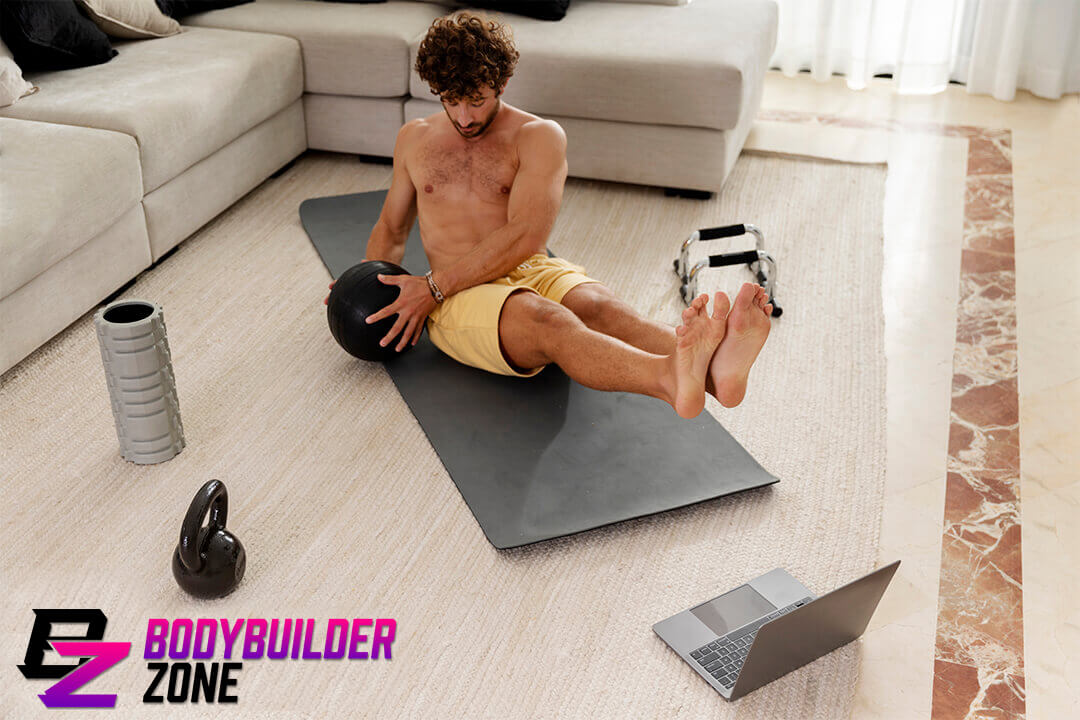
Home workouts can be done without equipment and do exercises with your weight. These can be squats, lunges, planks, or push-ups. By adding dumbbells and kettlebells, your workout will become more effective. Gym workouts provide the opportunity to train using machines and free weights. This is suitable for those who want to work on specific areas and achieve results faster.
It all depends on your personal preferences and goals. It is worth adapting the workout program based on this to ultimately achieve the desired result.
5. The Importance of Periodization in Training
You need to adhere to periodization in your training, as this is one of the key factors in achieving results.
Periodization for maximizing results
The essence is that it is necessary to alternate periods of high and low intensity, volumes and types of loads in the training plan. It is not recommended to do only strength training or do cardio alone.
Types of periodization
- Linear periodization works on the principle as its name suggests. Gradually, the intensity of training increases and the volume decreases over a long period.
- In block periodization, training is divided into blocks. Each of these blocks focuses on a certain aspect, for example, hypertrophy, strength, or endurance.
- Wave periodization combines elements of the two previous ones. With this type of periodization, the volume and intensity change dynamically – this can happen both in one workout and in one week.
Try to follow the priority and not overload the body. This can negatively affect your health and training will not give results.
6. Common Mistakes When Choosing a Workout Program
Due to a lack of sufficient experience, many people make mistakes when choosing an exercise program. Let’s pay attention to the most common mistakes and what to do to avoid them:
Starting too intensely
Starting and performing intense exercises too abruptly will only harm you. This is fraught with severe muscle pain since no preliminary preparation was carried out. It is always worth starting with warming up the muscles. This can be done on a treadmill or a bicycle-type exercise machine.
Ignoring your body’s signals
Most often, the body itself tells you that something is wrong. For example, if you have weak joints, then after training you will feel pain in them. This can be due to improper exercise performance and non-compliance with technique.
Underestimating the importance of rest and recovery
After completing your workout, you need to rest for 1–2 days. Because it is during the rest period after training that muscles grow and tissues are restored. Therefore, you should not neglect rest and think that the more and harder you train, the faster you will see the result.
If any injuries or health problems occur, be sure to consult a doctor and a trainer. He will help identify the cause and create a workout plan for you with safe exercises.











Leave a comment